
热门搜索: 假扮女佣
康熙王朝
Exclusive: China's maritime court settles Strait of Hormuz vessel collision dispute as foreign shipowners turn to Chinese law_我的网站

A | 近期,俄罗斯军队针对乌克兰首都基辅的工业与物流设施展开了又一轮大规模远程打击,而这些攻击不仅造成了财产损失,更令无辜平民遭受了伤痛。
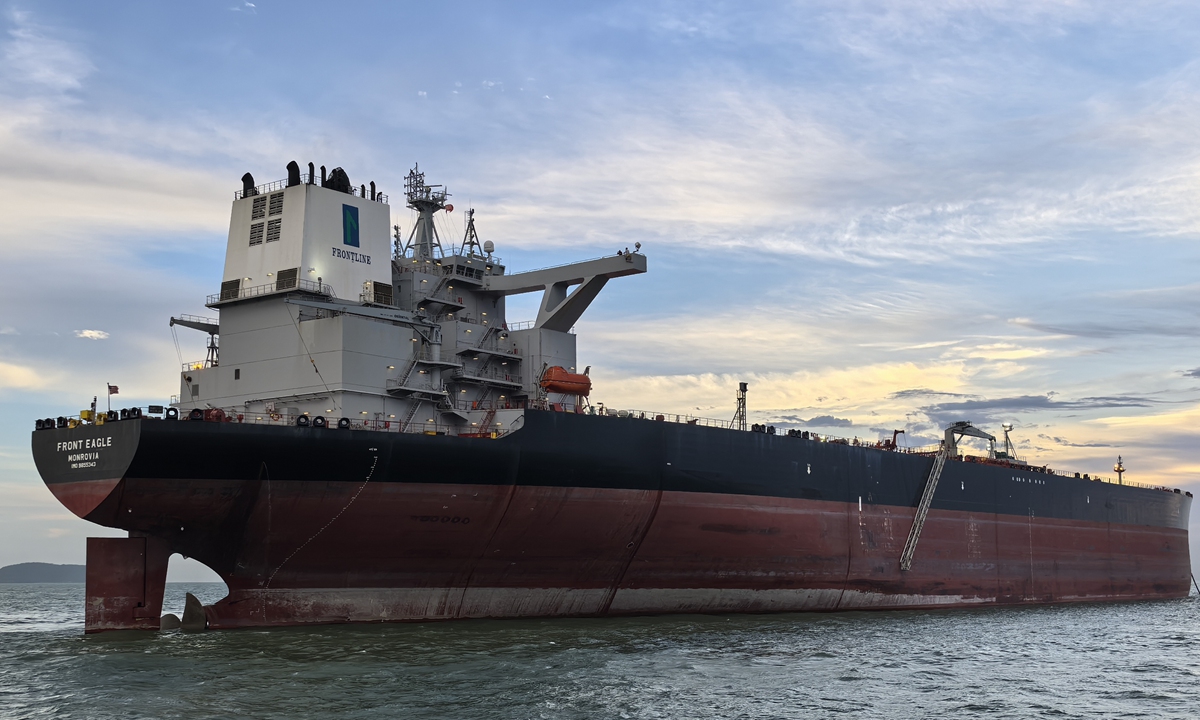
In 2025, two crude oil tankers collided at the eastern entrance to the Strait of Hormuz, 24 nautical miles off Fujairah, United Arab Emirates, media reported.
Owned by oil tanker operator Frontline, the Liberia-flagged vessel Front Eagle collided with the Antigua and Barbuda-flagged vessel Adalynn on the morning of June 17, 2025.
The Adalynn was damaged in the fire. While the Front Eagle was undergoing repairs in Shenzhen, South China's Guangdong Province, Global Shipping Holding Ltd., which owns the Adalynn, applied to Guangzhou Maritime Court for its arrest. Frontline provided a cash security of 203 million yuan to release the arrest and applied to establish a limitation fund for maritime claims.
The court approved the application and allowed Frontline to establish the limitation fund, setting the amount of the fund at 168 million yuan.
Guangzhou Maritime Court held four pretrial conferences on October 11, 2025, January 12, May 6 and July 13, 2026 to complete preparations for evidence examination, technical investigations and reported the relevant pretrial arrangements to the provincial high court, the Global Times learned from the court.
The court held a public hearing for the case on July 14, 2026.
No government agency had conducted an investigation into the collision, and no official findings were issued after the accident. Taking into account the unique burden-of-proof challenges in maritime collision disputes, Guangzhou Maritime Court took measures to preserve key evidence when handling the vessel arrest, including navigation logs, AIS data, voyage data recorder (VDR) records and CCTV footage, the court told the Global Times in a statement on Sunday.
Under a process that involves exchanging evidence inventories, sealing materials simultaneously and jointly reviewing them after evidence submissions, the court helped ensure the authenticity of critical records and laid the groundwork for determining the facts of the case.
As the two sides and their respective maritime experts reached sharply different conclusions over liability, the court introduced a maritime technical investigator mechanism, with the consent of both parties, allowing technical experts to participate throughout the proceedings. Drawing on the preserved evidence, investigators reconstructed the collision, assessed the vessels' encounter situation and clarified the parties' respective responsibilities.
Following the hearing, the court facilitated mediation, and the two parties reached a settlement agreement on July 27, 2026. On July 31, the court organized the distribution of the maritime liability limitation fund among creditors involved in the foreign vessel collision dispute and related charter-party disputes.
Representatives of the Adalynn traveled from overseas to the court to present a letter of appreciation and a commemorative banner in recognition of the court's efforts, according to the court statement.
After the Guangzhou Maritime Court accepted the case, both parties agreed to apply Chinese law to establish a maritime liability limitation fund and resolve their substantive dispute, breaking away from the long-standing reliance of international shipping disputes on European and US courts and legal systems.
Choice of justice
Bilov Viacheslav, a representative of Global Shipping Holding Ltd., told the Global Times that the main reason they chose a Chinese court to mediate the case is that "we want absolutely fair, unbiased approach to this issue. Because nowadays in this world, there are some countries which believe that they are authorized to give instruction to all others, which definitely is having influence on the decisions of the judge on the approach to the case."
Viacheslav gave the Chinese court's handling of the case a five-star rating, saying he had expected the dispute to take at least three years to resolve, but the Chinese court settled it within just one year. He also praised the judges and lawyers for their commitment to advancing the case throughout the proceedings.
"The judges and lawyers worked to advance the case with the same level of commitment as I did, even though the case directly concerned my own interests. This left a deep impression on me about litigation in China," Viacheslav said.
The case involved two foreign parties and a collision that occurred near the Strait of Hormuz, with no direct connection to China or Guangzhou Maritime Court initially. The fact that the parties chose to seek vessel arrest in China and agreed to apply Chinese law demonstrates the credibility and appeal of China's maritime judicial system, Wu Guining, vice president of the Guangzhou Maritime Court, who served as the presiding judge of the case, told the Global Times.
The court also introduced a maritime technical investigator mechanism in the case, an innovation aimed at addressing complex technical issues arising from vessel collision accidents, Wu said, noting that through technical investigations, the court was able to establish the facts of the case more efficiently, highlighting the integration of professional maritime investigation capabilities with China's specialized maritime adjudication system.
The case demonstrates China's ability to handle major, complex and cross-border maritime disputes with professional expertise, Wu said.
The handling of the collision between the two vessels is just one example of how Chinese courts have been dealing with a growing number of foreign-related maritime cases in recent years.
The Global Times learned from China's Supreme People's Court (SPC) in October last year that over the past 40 years, Chinese courts have handled a total of 88,000 foreign-related maritime cases involving parties from 146 countries and regions.
At a lecture held by the SPC on Friday, Shen Hongyu, director of the Fourth Civil Division of the SPC, told the Global Times that in recent years, Chinese courts have become more influential in participating in and promoting global ocean governance reform. Maritime justice serves as an important instrument for practicing the vision of a maritime community with a shared future and for advancing the reform of the global ocean governance system.
。与此同时,普京在接受媒体采访时对外界提出的调解方案表达了“不屑一顾”的态度,他认为这些方案“十分离奇”,根本无法被俄罗斯所接受。 普京的表态并不简单地意味着拒绝对话,相反,它向外界传达了一种警告:任何解决方案都必须尊重当前的地面现实。这是一种战略上的较量,表面上看,俄罗斯方似乎是在划定谈判的底线,实际上却是在为自己寻找合适的谈判时机和空间。 外界对调解方案的讨论往往流于表面,很多提议甚至缺乏对现状的深入理解。自2019年冲突升级以来,战场形势已经发生了翻天覆地的变化,各方对领土控制和安全需求的认知也随之改变。在这一背景下,要求俄罗斯立即退回到冲突爆发前的状态的提案,显然是与现实脱节的。 在漫长的战争中,无论是俄罗斯还是乌克兰,都在不断地耗尽各自的资源。普京意识到,维持这样一种耗损状态并非长久之计,因此他对于谈判的开放态度暗示了寻求某种解决方案的必要性。然而,保持谈判的可能性并不意味着完全放弃战争,恰恰相反,这是为了在适当的时机掌握主动权。 西方媒体普遍倾向于将俄方对基辅的持续轰炸解读为“施压策略”,认为这是为了逼迫乌克兰尽快接受其条件。然而,远程打击的效果有限,毕竟,仅凭空袭无法彻底转变一个国家的立场。攻击的目标主要集中在无人机零部件厂和物资仓库,目的是削弱乌克兰在战场上的持久作战能力。这一战术虽然能在短期内造成一定影响,但要想彻底决定冲突的走向,依然需要考虑前线的实际对峙情况、双方的国内承受能力以及外部的援助力度。

B | 相比于俄罗斯,乌克兰的处境显得更加困难。最近,乌克兰出现了多起征兵骚乱事件,街头抓壮丁的粗暴做法引发广泛的民愤。在利沃夫,一名年轻人因拒绝参军而持刀攻击征兵工作人员,最终导致对方死亡,这一悲剧使得人们不得不重新审视战争对普通民众生活的影响。 抗拒被动员的情绪,背后是更深层的社会矛盾。根据乌克兰人权机构的数据显示,征兵过程中违规行为的投诉不断增加,许多年轻人因为家庭背景或经济条件而被区别对待,而普通家庭的孩子则常常成为被强行带走的对象。这种不公正的现象,毫无疑问地在不断侵蚀着动员制度的公信力。 乌克兰当局面临着两难的选择。

C | 一方面,前线急需兵员,动员制度不能轻言取消;另一方面,继续沿用当前粗暴的执行模式只会加剧社会对立,激化矛盾。士兵的质量比数量更加重要,一支由恐惧驱动组建的军队,未必能在战场上发挥应有的作用。 在现代战争中,士兵的心理状态直接关系到战斗力的发挥,因而依靠强制手段招募的人员,并不一定能够成为可靠的战斗力。这一潜在风险似乎也已被乌克兰高层所认识,他们正试图通过审查地方征兵制度来解决问题。

D | 然而,高层的意图能否贯彻到基层执法环节,仍然是一个令人担忧的问题。

E | 随着冲突的持续,乌克兰民间的抵触情绪也在逐步升温。尽管社会上依然存在愿意为国参战的群体,但民众对动员制度的不满与抗拒,可能会在未来引发更大的社会动荡。

F | 值得注意的是,民间抗议并不意味着即将爆发全国范围的暴乱,但随着时间的推移,内部矛盾的积累将会给双方的战争进程带来新的挑战。

G | 总的来看,俄乌冲突的现状映射出国际关系中的诸多复杂因素,而未来的走向,不仅仅取决于战场上的局势,还受制于双方国内的承受能力和国际社会的介入程度。虽然目前尚无法预见具体的结局,但可以明确的是,冲突的持续只会让各方的伤痛不断加重,在这种情况下,寻找一条合理的解决路径,显得更加紧迫。返回,查看更多。
Current article:http://aqy2i.zhouangnaoguangsundianzhenmou.cfd/list_yi89tra/lp1c.html
Published on:18:11:30
栏目相关
- 利好都摆在了桌面上,创新高需更大支撑力
- 日本最大进口车经销商谈为什么卖比亚迪:他们的电动车卖到了全球销量第一
- Mrs Deshpande Trailer: Madhuri Dixit Returns in a Dark New Avatar
- Ecuadorian president to pay state visit to China; trip to consolidate high‑level mutual trust, forge more cooperation consensus: expert
- フェラーリ新型テスタロッサ、1036馬力の正体。SF90から何が変わり、何が変わらなかったのか
- 海马课堂
- 8500万还在养伤,7500万已经进球:曼联锋线的“意外”主角
- Grand Theft Auto V 传承版 粉丝利用数字取证专业知识揭露 GTA6 泄露者的加密货币骗局
- 摩根士丹利与施罗德参投澳洲最大风投基金,黑鸟创投募资7.5亿美元
- 30岁女教师性侵两名男学生被逮捕,保释期间将魔爪伸向另一名男生并怀孕
- 【黑色早评】山西长治一座煤矿复产,京唐港印尼焦煤入晋专列开通
- 在新加坡招一个本地员工,月薪多少合适?还有其他开销吗?
热门排行
- 打破多项人类运动纪录 机器人性能持续进阶,打破多项人类运动纪录 机器人性能持续进阶
- G1火箭85-95不敌勇士 球员评价:申京满分,5人及格,2人崩盘
- 太猖獗!四名劫匪持斧头抢劫奥克兰加油站,员工差点爆头而亡
- 関東各地で山火事相次ぐ 自衛隊ヘリなどが消火活動 栃木・鹿沼市 茨城・常陸太田市 ともに未だ延焼続く 神奈川・小田原市 鎮圧も消防隊員1名が体調不良で緊急搬送
- 田径世锦赛:张德顺女子马拉松名列第11 创个人第二好成绩
- 售52.18万起 2025款奥迪S4 Avant正式上市 标配抬头显示
- 'अगर मैं दलीप ट्रॉफी के लिए फिट हूं, तो Asia Cup के लिए क्यों नहीं....', Mohammed Shami का दर्द आया सामने
- 哈利伯顿不满复出首战安排:客场无直播令人震惊
- 曾创吉尼斯纪录!百斤大西瓜上市 快递小哥直接用上爬楼机送货
- B'desh tops apparel export growth to EU
- 新能源这桌菜,锂矿主吃肉 “宁王”“比茅”只配喝汤?
- 杭台高铁温玉段今日开通运营 杭州至玉环最快1小时47分高铁直达